
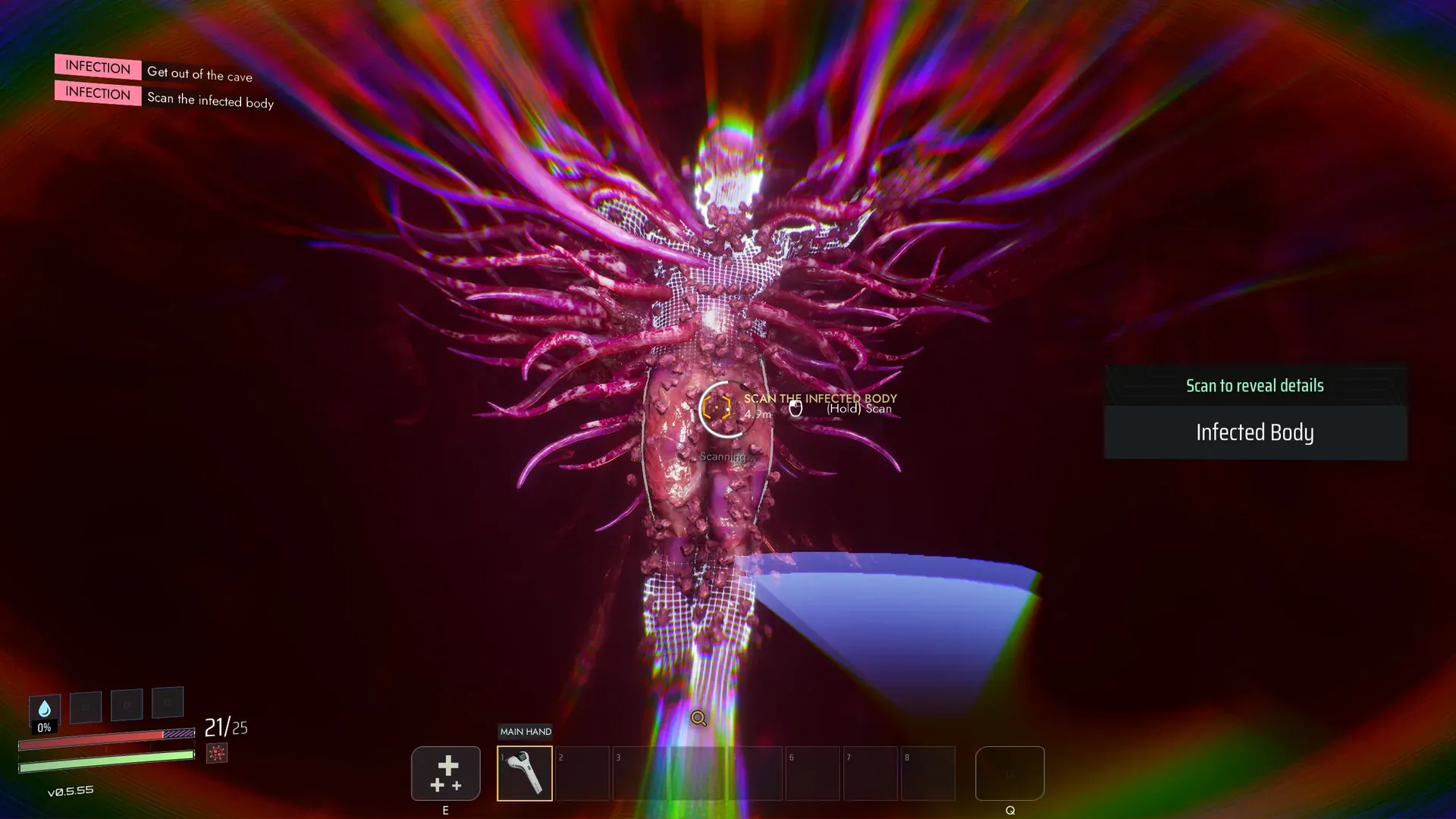
Official screenshot — Pokuch / META Publishing
Scanning and the codex: how discovery becomes progression
The scanner is the game’s knowledge engine. It identifies lifeforms, minerals and anomalies, adds codex entries, and unlocks crafting recipes. The Holowatch holds the fog-of-war map and contextual suggestions.
Brief / key takeaways
- Scanning unlocks recipes and lore, not just labels.
- The scanner is part of your regular equipment and is the subject of the opening quest.
- The Holowatch holds the fog-of-war map and suggestions.
- Scan unknown objects before harvesting or fighting them.
- Scan speed was improved in the 2025 demo; launch behaviour may differ again.
What scanning does
“The scanner gives you information and even unlocks crafting recipes,” the developer explains. The example is an egg-shaped organism that, once scanned, is revealed as an explosive material. A durable creature shell, once scanned, can become armour.
The demo FAQ adds three outputs: “lore, hidden recipes, and crucial info.” That means the scanner is simultaneously a bestiary, a recipe book and a hazard warning system.
The playtest FAQ describes scanning as part of the core loop, alongside a fog-of-war map viewable on the Holowatch. The two tools are complementary: the scanner tells you what a thing is; the map tells you where it is.
A scan routine
- Scan at a distance first. You do not need to touch a creature to identify it, and some creatures punish proximity.
- Scan the ground layer. Small fauna, fungi and mineral nodes are easy to miss when you are looking at the horizon.
- Scan before harvest. An unidentified plant is inventory weight; an identified one is a component.
- Re-scan after patches. New tags, recipes and creature behaviours have been added repeatedly during development.
- Check the codex after a new biome. The entries are the game’s tutorial for that ecosystem.
Scanning in co-op
The world and quests are shared, but you should not assume every player has read every codex entry. In practice:
- Call out new entries by name, not by description.
- Let the surveyor scan while the engineer builds; splitting attention is the point of a squad.
- If a resource is needed for a recipe, confirm that someone has scanned the source before the group commits to a farm route.
Limits and unknowns
- Whether scanning has a cooldown, a battery cost, or a range limit is not published.
- Whether some creatures require multiple scans is unknown.
- Whether codex completion is tracked per player or per save is unconfirmed.
- The “scan speed improved” note comes from the 2025 demo; the launch build may have changed again.
If a scan does not register, move closer and re-aim. The scanner has a target acquisition step, like telekinesis, and it has been patched for reliability before.
Questions
3 answeredDoes scanning replace the codex?+
The codex is the record; scanning is how you fill it. The two are part of the same system.
Can I scan creatures while they are attacking me?+
Probably, but it is not a good plan. Scan from safety; the information persists.
Do I need to scan things I already know?+
Unknown. Some games require a scan per save; others persist account-wide. Test it in the launch build.
Sources for this dossier
·