
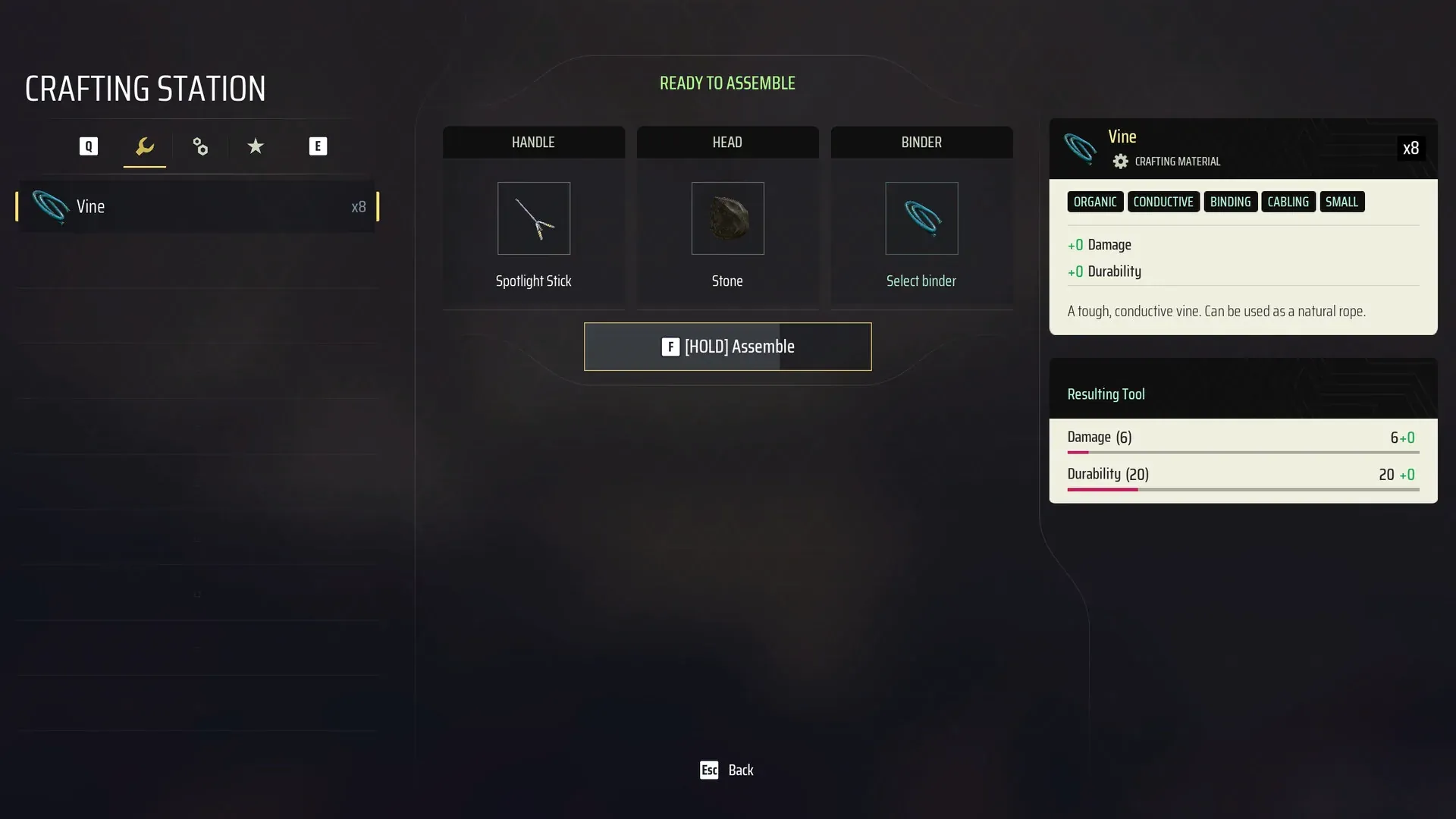
Official screenshot — Pokuch / META Publishing
Modular crafting explained: handle, head and binder
There is no fixed recipe list for gear. You assemble a tool from a handle, a head and a binder, and the properties of those parts decide what the tool can do. The game’s crafting station makes the logic visible.
Brief / key takeaways
- Three slots: HANDLE, HEAD, BINDER.
- Parts carry tags such as ORGANIC, CONDUCTIVE, BINDING, CABLING and SMALL.
- The head sets damage type; the handle sets reach and archetype; the binder completes the build.
- The documented starter build is Spotlight Stick + Stone + Vine.
- Scanning is how you discover valid parts.
The three-slot anatomy
The official crafting station screenshot shows three columns: HANDLE, HEAD and BINDER, with a “READY TO ASSEMBLE” state when all three are filled. In the example, a Spotlight Stick handle and a Stone head are joined by a Vine binder.
The vine’s tooltip reads: “A tough, conductive vine. Can be used as a natural rope.” Its tags are ORGANIC, CONDUCTIVE, BINDING, CABLING and SMALL. Its bonuses are +0 Damage and +0 Durability. The resulting tool shows Damage 6 and Durability 20.
That tells you the binder is structural, not statistical. It is required to finish the tool, and its tags describe what the tool can interface with. A conductive binder may matter for powered or electrical builds later; a binding-only binder may simply hold the head.
What each slot decides
| Slot | What it appears to control | Evidence |
|---|---|---|
| Handle | Reach, archetype, weapon class | Stone Mallet card: HANDLE · PIPE · LONG · INDUSTRIAL; “uses slow, heavy swings”. |
| Head | Damage type and base damage | Stone head produces 6 damage and BLUDGEONING. |
| Binder | Completion and material properties | Vine adds +0/+0 but carries five functional tags. |
The tags are the interesting layer. They are not stat modifiers; they are capability descriptors. That is why the system can support axes, spears, bows and rifles without a separate recipe for every combination.
Discovery, not unlocks
“Since this is an alien world, it’s not like you know everything from the start,” the developer explains. “The scanner gives you information and even unlocks crafting recipes.” The example: scan an egg-shaped organism and learn it can be used as an explosive material; scan a durable shell and learn it can become armour.
This means the crafting tree is gated by observation, not by a menu. If a part is not showing up in the station, the answer is usually to scan more of the thing you found, not to grind a level.
How crafting meets combat
Weapon type matters more than raw damage. A 2026 balance patch made two-handed weapons consume 50% of stamina per shot, keeping the same shot speed as short weapons, and made stamina “the main factor differentiating combat with different weapon types.”
The practical reading: a heavy build is a commitment. It competes with sprinting, climbing and escaping. A light build sacrifices stagger and reach for endurance. The Stone Mallet’s described role — break surfaces, stagger large creatures — is a utility function you may want even after you have a better killing weapon.
Mutations add a third layer: the developer says a shield can start as a basic defensive tool and, with a mutation, be used offensively. That implies modular gear is designed to be modified by both parts and biology.
Questions
3 answeredAre there fixed weapon recipes?+
The system is modular rather than recipe-list-based for gear. Advanced cooking and medical items do use fixed recipes, such as the Explorer’s Sausage and the Infection Suppressor.
Do better materials always mean more damage?+
No. Materials carry tags and damage types. A higher-tier part may add utility rather than raw damage.
Can I craft without the crafting station?+
The documented assembly flow uses a crafting station. Whether field crafting exists at launch is unconfirmed.
Sources for this dossier
·